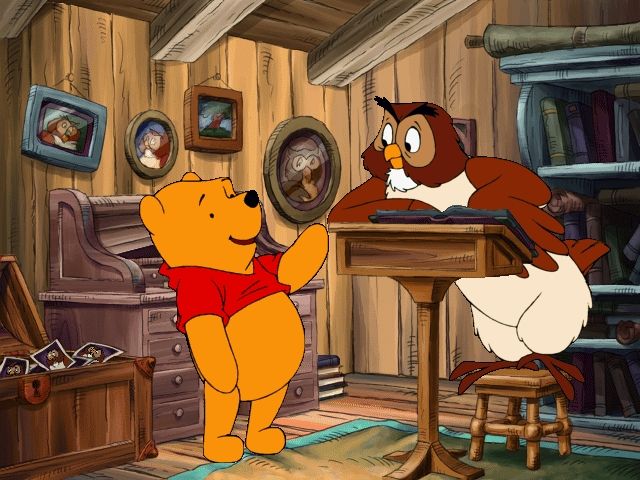
A. A. Milne named the character Winnie-the-Pooh after a teddy bear owned by his son, Christopher Robin Milne, on whom the character Christopher Robin was based. The rest of Christopher Milne's toys – Piglet, Eeyore, Kanga, Roo, and Tigger – were incorporated into Milne's stories. Two more characters, Owl and Rabbit, were created by Milne's imagination, while Gopher was added to the Disney version. Christopher Robin's toy bear is on display at the Main Branch of the New York Public Library in New York City.
Christopher Milne had named his toy bear after Winnie, a Canadian black bear he often saw at London Zoo, and Pooh, a swan they had encountered while on holiday. The bear cub was purchased from a hunter for C$20 by Canadian Lieutenant Harry Colebourn in White River, Ontario, while en route to England during the First World War. He named the bear Winnie after his adopted hometown in Winnipeg, Manitoba. Winnie was surreptitiously brought to England with her owner, and gained unofficial recognition as The Fort Garry Horse regimental mascot. Colebourn left Winnie at the London Zoo while he and his unit were in France; after the war she was officially donated to the zoo, as she had become a much-loved attraction there. Pooh the swan appears as a character in its own right in When We Were Very Young.
In 1925 Milne, a Londoner, bought a country home a mile to the north of the forest at Cotchford Farm, near Hartfield. According to Christopher Milne, while his father continued to live in London "...the four of us – he, his wife, his son and his son's nanny – would pile into a large blue, chauffeur-driven Fiat and travel down every Saturday morning and back again every Monday afternoon. And we would spend a whole glorious month there in the spring and two months in the summer." From the front lawn the family had a view across a meadow to a line of alders that fringed the River Medway, beyond which the ground rose through more trees until finally "above them, in the faraway distance, crowning the view, was a bare hilltop. In the centre of this hilltop was a clump of pines." Most of his father's visits to the forest at that time were, he noted, family expeditions on foot "to make yet another attempt to count the pine trees on Gill's Lap or to search for the marsh gentian". Christopher added that, inspired by Ashdown Forest, his father had made it "the setting for two of his books, finishing the second little over three years after his arrival".
Christopher Robin's teddy bear made his character début, under the name Edward, in A. A. Milne's poem, "Teddy Bear", in the edition of 13 February 1924 of Punch (E. H. Shepard had also included a similar bear in a cartoon published in Punch the previous week), and the same poem was published in Milne's book of children's verse When We Were Very Young (6 November 1924). Winnie-the-Pooh first appeared by name on 24 December 1925, in a Christmas story commissioned and published by the London newspaper Evening News. It was illustrated by J. H. Dowd.
On 6 January 1930, Stephen Slesinger purchased US and Canadian merchandising, television, recording, and other trade rights to the Winnie-the-Pooh works from Milne for a $1,000 advance and 66% of Slesinger's income, creating the modern licensing industry. By November 1931, Pooh was a $50 million-a-year business. Slesinger marketed Pooh and his friends for more than 30 years, creating the first Pooh doll, record, board game, puzzle, US radio broadcast (on NBC), animation, and motion picture.
After Slesinger's death in 1953, his wife, Shirley Slesinger Lasswell, continued developing the character herself. In 1961, she licensed rights to Walt Disney Productions in exchange for royalties in the first of two agreements between Stephen Slesinger, Inc., and Disney. The same year, A. A. Milne's widow, Daphne Milne, also licensed certain rights, including motion picture rights, to Disney.
Since 1966, Disney has released numerous animated productions starring its version of Winnie the Pooh and related characters, starting with the theatrical featurette Winnie the Pooh and the Honey Tree. This was followed by Winnie the Pooh and the Blustery Day (1968), and Winnie the Pooh and Tigger Too (1974). These three featurettes were combined into a feature-length movie, The Many Adventures of Winnie the Pooh, in 1977. A fourth featurette, Winnie the Pooh and a Day for Eeyore, was released in 1983.